AFCPE Symposium Awards: Outstanding Symposium Poster Award
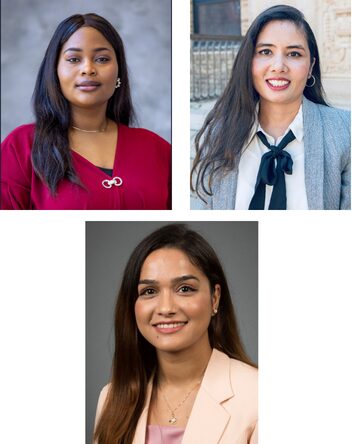
The Outstanding Symposium Poster Award recognizes AFCPE members whose research and innovative work are advancing the field of financial counseling, coaching, and education. Congratulations to 2025 recipients Olamide Olajide PhD, AFC®, Ichchha Pandey, PhD, CFP®, and Sabina Pandey, PhD, CFP® for “Social Media for Investment Advice and Financial Satisfaction: Does Generation Matter?”
Celebrating Our Outstanding Symposium Poster Award Winners
2025: Olamide Olajide PhD, AFC®, Ichchha Pandey, PhD, CFP®, and Sabina Pandey, PhD, CFP®

This poster examines how different generations turn to social media for investment advice — and whether that reliance affects their overall financial satisfaction. As platforms like TikTok, Instagram, and YouTube increasingly become go-to sources for financial guidance, this research explores whether the generation of the user — from Gen Z to Baby Boomers — shapes how they engage with social media financial content and how that engagement influences their sense of financial well-being. The findings offer valuable insights for financial counselors and educators seeking to meet clients where they are in an increasingly digital financial landscape.
2024: Lynn McHann
“Laughing All the Way to the Bank: A YouTube Guide to Financial Wellness for Young Adults” is designed for financial wellness industry professionals eager to learn about engaging young adults through digital media. Our YouTube series breaks down complex financial concepts into fun, easy-to-understand episodes that resonate with a younger audience.
The poster details content strategy, audience engagement techniques, and the educational outcomes observed from the series. With humor and relatable storytelling, it transforms traditional financial education into captivating content that empowers young adults to make informed financial decisions.
2023: Jenni Whiteley and Yoon G. Lee
Today’s young adults are facing unprecedented barriers to making ends meet and securing their financial futures. In order to meet these financial challenges, financial educators, counselors, and planners will need to instruct and encourage young adults to diligently implement beneficial short-term and long-term financial behaviors. However, research shows that merely teaching them about good financial behavior is not enough to encourage behavior change. “Financial Perceptions, Financial Literacy, and Financial Behaviors among Young Adults aged 18-34” addressed psychological aspects of finances by investigating the impact of financial perceptions (financial worries and anxiety) and financial literacy (knowledge, application, and confidence) on financial behavior among young adults. The result of this study indicated that financial perceptions are significantly associated with young adults’ financial behaviors. The findings of this study can help inform financial professionals as to areas of needed education and if/when clients need to be referred to psychological professionals.
2022: Leslie Green and Narang Park
The racial homeownership gap in Travis County, Texas is examined by assessing the association of race and mortgage loan denial using 2020 Home Mortgage Disclosure Act data. The results from “Barriers to Homeownership: Mortgage Loan Denials in Travis County, Texas.” show that African Americans, Asians, and Hispanics are between 1.64 and 2.26 times more likely to be denied a mortgage loan than White non-Hispanic applicants. The most common reasons for being denied are debt-to-income ratio and credit history. Implications for homeownership counseling and initiatives are discussed.
2021: Lorna Saboe-Wounded Head and Mia Russell
An estimated 14 million college students were suddenly confronted with COVID-19 forcing them to navigate cancelled classes, remote learning, lack of social interaction, and abrupt relocation due to campus closures. Since the start of the pandemic, students have grown increasingly concerned about their financial future, employment opportunities, ability to manage money and afford college. The purpose of this study was to examine the extent to which COVID-19 influenced the relationship between financial well-being, needs satisfaction, and college persistence among college students. Findings from this study demonstrate the importance of financial well-being in students’ success and persistence in college. Suggestions on how higher learning institutions, university administrators, and faculty can support their students amid COVID-19 are provided.
2020: Camaya Wallace Bechard
The 2020 Poster Award went to “Using Needs Assessments to Support Financial Literacy Programs in Non-Profit Agencies.” This poster presentation examined the role of needs assessment in designing or supporting financial education programs in non-profit agencies. This presentation included findings from a study with agency staff who works to deliver financial education for low-to-moderate-income individuals. It also focused on considerations for conducting financial education needs assessments in Extension.
2019: Bonnie Braun, Virginia Brown, Jesse Ketterman, Lynn Little, Lisa McCoy, Dorothy Nuckols, and Maria Pippidis
University of Maryland Extension

The 2019 Poster Award went to “Protecting Financial Well-Being: Managing and Resolving Health Insurance Disputes”. Results of this study demonstrate that financial educators and counselors can successfully prepare consumers to understand their healthcare bills, appeal health insurance claim decisions, and resolve health insurance billing disputes.
2018: Erica Tobe and Robert Weber
This poster evaluates the effectiveness of the counseling intervention of 265 clients over a two-year period to see if participants who received education and counseling from a HUD certified counselor are better able to repay their delinquent payment and avoid property tax foreclosure. Key demographics and financial ratios have been evaluated. Using these factors, the findings will help predict if a client was successful in repaying their debt to the Treasurer’s Office. Implications for future research and practitioner guidelines have been generated to support practitioners to better work with this vulnerable population.
2017: Emily Koochel
Emily Koochel is a PhD student at Kansas State University, and a graduate teaching assistant in the Applied Family Science program. Her research interests include financial transparency and financial management strategies as it relates to marital satisfaction, pre-marital financial counseling and financial disclosure as predictors of marital dissolution. In 2011, Emily received her BS in Financial Planning from Kansas State University, her MS in Personal Financial Planning from Texas Tech University in 2013, and MS in Family Studies and Human Services in 2017 from Kansas State University.
Our Members Are Leaders in Financial Research. Join Our Community
Expand your reach and deepen your impact by joining a diverse community of financial professionals, researchers, practitioners, and educators with exclusive access to awards, grants, and career-advancing opportunities.
Comments are closed.