Celebrating Previous Recipients of the Mary O’Neill Mini Grant
The work of these deserving individuals and organizations to impact communities is in keeping with the commitment of grant’s namesake. We sincerely thank Dr. Barbara O’Neill, an AFCPE member and Past President of AFCPE, for her continued generosity in honoring her late mother, Mary O’Neill, a financially capable woman.
Previous Mary O'Neill Mini Grant Recipients
2025: The Plootus 21-Day Financial Habits Challenge
Plootus
The Plootus 21-Day Financial Habits Challenge will deliver evidence-based daily micro-actions to build sustainable financial wellness habits among individuals from under-resourced and underserved communities. Through strategic partnerships with professional organizations and employers, the program will provide participants with practical tools for budgeting, saving, debt management, and emergency planning while creating a replicable model for nationwide implementation by AFCPE® members.
2024: Asset Management Properties (AMP) Financial Empowerment Project
Pilar Pangelinan, AFC®
The AMP Financial Empowerment Project delivers accredited financial counseling and coaching services to HUD-assisted families living in public housing under the Guam Housing and Urban Renewal Authority (GHURA). The program enhances money management skills and equips residents with the tools to achieve long-term financial stability.
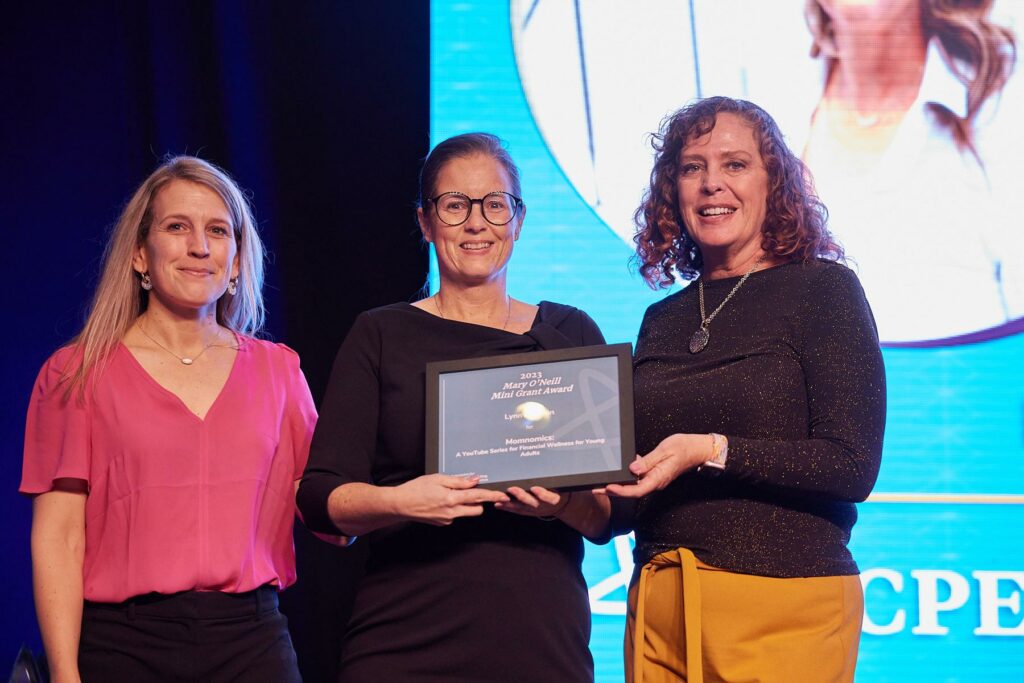
2023: "Momnomics”: A YouTube Series for Financial Wellness for Young Adults
Lynn McHann, AFC®
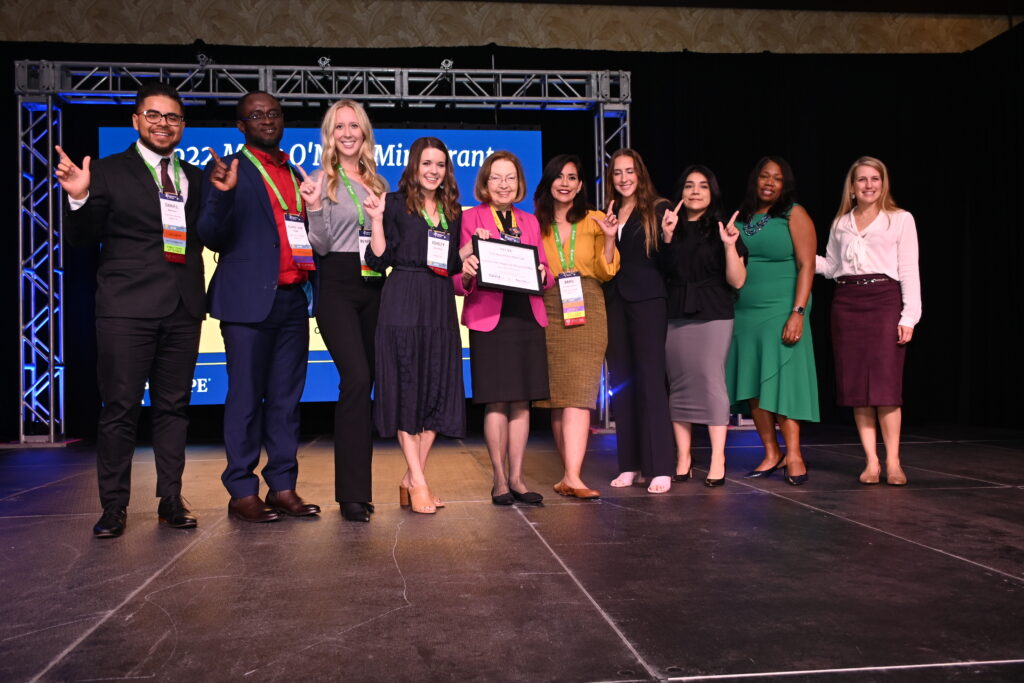
The project, “Momnomics”: A YouTube Series for Financial Wellness for Young Adults,” aims to deliver crucial financial literacy education to young adults aged 18-30 through a series of engaging, high-quality YouTube videos, covering topics like budgeting, debt management, investing, and retirement planning in an easily digestible, relatable manner.
2022: Knowledge Empowering You (KEY)
Financial Coaching Sessions with Focus on Reentry
Texas Tech University - Center for Financial Responsibility

The Knowledge Empowering You (KEY) program utilizes Texas Tech University Personal Financial Planning students to provide educational outreach to the Lubbock area community. Specifically, students in the organization must have completed the education requirement to sit for the AFC®. Providing university students with opportunities to work with a variety of populations is crucial in their development as financial professionals.
In order for KEY volunteers to effectively serve inmates at LCDC, they will need to participate in specialized training. Texas Tech’s Personal Financial Planning courses provide a foundation of knowledge that is needed to understand clients’ personal finances. Students working with LCDC inmates will need additional training on policy, resources, and strategies for working with individuals with criminal records. This training will include sensitivity awareness, community resources, and strategies when providing financial education surrounding reentry.
KEY students will provide financial coaching sessions at the Lubbock County Detention Center or virtually. Sessions will be one hour with a focus on the client’s personal finances. Topic areas can include the following:
- Financial goal setting
- Budgeting
- Opening a bank account
- Payday loans
- Credit report/score/repair
- Purchase a car/car insurance
2021: Breaking Out of Financial Aid Fog
Lorna Saboe-Wounded Head
South Dakota State University Extension
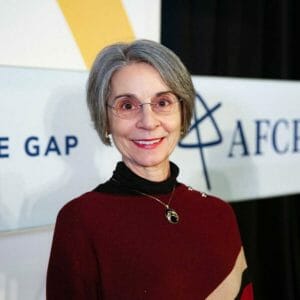
The program “Breaking Out of Financial Aid Fog” is modeled after an Escape Room activity. Participants will be given a locked toolbox and a set of instructions. Inside the toolbox will be another locked box with multiple locks. Participants will need to complete a series of activities, in order, to get the code to unlock each lock. The activities will be assignments on the topics of costs of college, the difference between the sticker and net price of a college, the different types of financial aid, financial aid forms, and criteria for selecting a college. Participants will work in teams of three to five students. Activities will be designed to complete both with or without computer/internet access. The program will be facilitated by a classroom teacher or youth advisor for out-of-school programs (4-H groups, teen clubs, etc.).
2020: Make Money Make $ense
Joyce Serido
The University of Minnesota Extension
Make Money Make $ense is a research-to-practice collaboration to engage youth in a process of financial self-discovery.
Joyce Serido, Associate Professor and Extensions Specialist at the University of Minnesota, and her Extension colleague Sharon Powell, will develop a financial toolkit to engage underserved youth to raise awareness about the connections between the choices they make and the impact on their well-being. The financial toolkit will include training videos and activities to encourage youth to learn from both good and bad choices. The activities will help youth make the connection between the choices they make and the outcome of those choices. They will partner with local youth serving organizations to pilot the materials in out of school programs.
2019: Money Week
Christopher Sneed
The University of Tennessee Extension

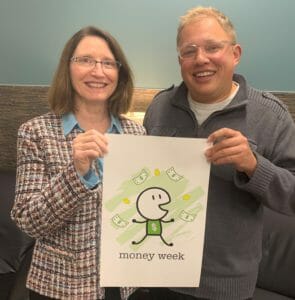
Money Week Pilot Report 2021 delivers financial education to limited-resource elementary school students through in-class instruction and read-aloud activities, covering topics like counting money, budgeting, and understanding wants and needs. Daily newsletters keep families engaged and reinforce key concepts at home. Aligned with state math and National Jump$tart standards, the program is backed by UT Extension and local financial institutions — and built for replication.
2018: Double Estate/Legacy Planning:
For persons with Alzheimer’s/other dementias and their caregivers.
Marsha A. Goetting plus the Legal and Financial Committee of the Montana Alzheimer’s Workgroup
A caregiver is faced with not only taking estate/legacy planning steps for a loved one with Alzheimer’s, but also for him/her self. A packet of legal and financial resources will be made available for Montana caregivers who do not have access to computers or dependable internet services. Doctors, physicians’ assistants, and nurse practioners will be informed of the availability of the packets for distribution to their patients. The packet’s content will also be made available on the web. Partners include the Montana Alzheimer’s/Dementia Workgroup, Montana State University Extension, Alzheimer’s Association–Montana, AARP-Montana Chapter, Department of Public Health and Human Services-Senior and Long Term Care Division, and State Bar of Montana.
2017: Student Loan TIPs (Texting Intervention Project)
Lorna Saboe-Wounded Head, Kathy Sweedler, David Evans, Suzanne Bartholomae, Elizabeth Kiss, Erica Tobe, Terry Clark Jones, Joyce Serido, Mary Jo Katras, Graham McCaulley, Andrew Zumwalt, Carrie Johnson, and Peggy Olive
Student Loan TIPs is a texting intervention project for college graduates who will begin the student loan repayment process. Participants receive text messages about the repayment process and resources available to help make repayment decisions. Funds from the grant will be used to develop an educational toolkit for Cooperative Extension professionals that will include information and procedures on how to implement the program. A component of the toolkit will be a series of four podcasts about student loan repayment. Members of the team are all Family Resource Management Extension Specialists representing the North Central region.
2016: Expanding Middle School Financial Education in Diverse Neighborhoods through the Use of the Money Dawgs Program
John Grable, Michael Thomas, Michelle Kruger, Kimberly Watkins & Kenneth White

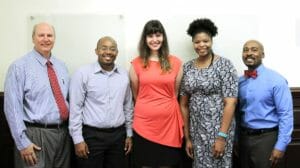
Money Dawgs was created as an alternative youth financial education initiative by AFCPE members teaching and taking classes in personal finance and financial counseling at the University of Georgia. Members of the team, from left to right, include John Grable, Michael Thomas, Michelle Kruger, Kimberly Watkins, and Kenneth White. The team has been providing week-long camps for middle school age children to learn about money management topics, wealth accumulation strategies, and general personal finance topics. Funds from the grant will be used to expand the Money Dawgs concept to meet the needs of children living in economically vulnerable neighborhoods.
2015: Starting Over After Foreclosure Toolkit
Erica Tobe and Brenda Long

The Starting Over After Foreclosure toolkit was developed to provide situation appropriate content to meet the unique needs of families. Early marketing efforts with Michigan partners identified an overwhelming need for this material and a need for additional avenues for delivery. To provide clients help beyond the toolkit format, MSUE is also in the process of developing a series of eight free stand alone classes with interactive videos that will be housed on the MSU Desire2Learn course management system. Each class utilizes toolkit content, Reflect and Connect questions and scenarios, downloadable/fillable worksheets, and web-based resources.
2014: SaveIt! App
Emily D. Sorenson & Clinton G. Gudmunson
Iowa State University
Building College Student Financial Literacy: A powerful tool to harness everyday spending decisions in reaching personal financial goals and to see the progress each step of the way. Designed as a teaching tool to set goals, track progress, and motivate good savings behavior. Development of the app was influenced by intervention principles of “gamification” and behavioral economics. Learn More.
2013: Financial Education Boot Camp
Ruth Brock, AFC®, Alabama Cooperative Extension

Financial Education Boot Camp: Building Teachers’ Capacity to Teach Personal Finance was a pilot program for Alabama Teachers, adapted from Barbara O’Neill, Rutgers University, and was conducted in 10 counties across the State of Alabama. One hundred ten teachers were trained to teach personal finance during the 2013-2014 grant cycles. The program was needed due to a new personal finance graduation requirement for Alabama public schools. Using a train-the-trainer model, teachers now have the knowledge, skills, and resources to share and replicate materials with others.
2012: Money Matter$:
Train-the-Trainer Video for Young Adults with Autism Spectrum Disorder
Paul Goebel & Rachel Grimes, AFC®, University of North Texas (UNT)
The Money Matter$ video project combined the financial literacy training expertise of the Student Money Management Center with the ASD programming expertise of the University of North Texas Kristin Farmer Autism Center to develop basic budgeting curriculum for young adults with ASD; create a train-the-trainer video to assist financial literacy practitioners in presenting basic budgeting curriculum to young adults with ASD; and provide free access to the video to financial literacy practitioners and trainers, families, schools, and ASD programming specialists as a download from the UNT SMCC and the Kristin Farmer Autism Center websites.
2011: Using Pocket Trackers in the Colorado Small Steps to Health and Wealth (SSHW)
Nancy Porter, Colorado State University & Laurel Kubin, AFC®
Colorado State University Extension
The first recipients of the $2,500 Mary O’Neill Financial Education Mini-Grant developed a “Pocket Tracker” teaching tool for use in the Colorado Small Steps to Health and WealthTM program. The Pocket Trackers are given to program participants to reinforce the “Track Your Current Behavior” strategy. The tool helps participants become more aware of how much they eat, move, and spend throughout a typical day or week, providing a baseline necessary for setting goals to improve their health and/or wealth by taking specific small steps. Each attendee in this session will receive a Pocket Tracker for personal use.
Interested in Applying for the Mini-Grant? Join Membership
Join a diverse and inclusive network of financial professionals, researchers, practitioners, educators, and volunteers to access grants, awards, professional development, and more. Grant eligibility is exclusive to AFCPE members.
Comments are closed.